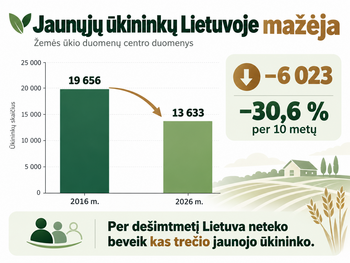
LT / EN – English version belowŽemės ūkio duomenų centro duomenimis, 2016 m. Lietuvoje buvo 19 656 jaunieji ūkininkai, o 2026 m. – jau tik 13 633. Per dešimtmetį jų sumažėjo daugiau kaip 6 tūkst., arba beveik 31 procentu.
Tuo metu Europos Sąjunga kartų kaitą žemės ūkyje įvardija kaip vieną svarbiausių sektoriaus ateities klausimų. Europos Komisijos kartų kaitos strategijoje nustatytas tikslas iki 2040 m. padvigubinti jaunųjų ir naujųjų ūkininkų dalį. Todėl Lietuvai kyla konkretus klausimas – kaip pasieksime bendrą ES tikslą, jeigu mūsų šalyje jaunųjų ūkininkų skaičius juda priešinga kryptimi?
Per pastaruosius dešimt metų Žemės ūkio ministerijai vadovavo devynios ministrų kadencijos, o politinė vadovybė keitėsi aštuonis kartus. Toks dažnas politinės vadovybės pasikeitimas dar labiau išryškina politikos nuoseklumo ir tęstinumo svarbą. Kartų kaita nėra vienos kadencijos uždavinys – tam reikia aiškių ilgalaikių tikslų, nuoseklių priemonių ir krypties, kuri būtų tęsiama nepriklausomai nuo to, kas tuo metu vadovauja ministerijai.
Jaunam žmogui pradėti ir įsitvirtinti žemės ūkyje vis dar labai sudėtinga:
· įsigyti ar išsinuomoti žemės;
· gauti finansavimą neturint didelio pradinio kapitalo ir užstato;
· konkuruoti su didelius finansinius ir žemės išteklius valdančiais subjektais;
· perimti veikiantį ūkį iš pasitraukiančio ūkininko;
· planuoti ilgalaikes investicijas nuolat keičiantis reikalavimams;
· gauti praktinių žinių, mentorystę ir sąžiningą kainą už pagamintą produkciją.
Todėl Lietuvai reikia ne dar vienos pavienės paramos priemonės, o nuoseklios nacionalinės kartų kaitos politikos su aiškiais ilgalaikiais tikslais. Ji turi padėti jaunam žmogui ne tik pradėti ūkininkauti, bet ir realiai įsitvirtinti, augti bei perimti veikiančius ūkius, kartu sudarant sąlygas į Lietuvą grįžti užsienyje patirties, žinių ir kapitalo sukaupusiems žmonėms, norintiems čia kurti savo ateitį.
Lietuvos jaunųjų ūkininkų ir jaunimo sąjunga siūlo:
1. Nustatyti konkretų nacionalinį tikslą, kiek jaunųjų ūkininkų Lietuva siekia turėti 2030 ir 2040 metais, ir reguliariai vertinti pažangą.
2. Sukurti vientisą jaunojo ūkininko įsikūrimo paketą, vienoje sistemoje sujungiant įsikūrimo paramą, lengvatinį finansavimą, geresnį žemės prieinamumą, konsultavimą bei praktinę mentorystę.
3. Sukurti palankias sąlygas į Lietuvą grįžti užsienyje patirties, žinių ir kapitalo sukaupusiems žmonėms, norintiems pradėti ūkininkauti ar perimti ūkį, užtikrinant realias galimybes gauti finansavimą ir įsigyti ar išsinuomoti žemę.
4. Užtikrinti skaidrią žemės rinką, kontroliuoti susijusius asmenis ir užkirsti kelią 500 ha ribos apėjimui bei žemės koncentracijai, kuri mažina kitų ūkininkų galimybes įsigyti žemės.
5. Sukurti veikiančią ūkių perdavimo sistemą, kuri sujungtų pasitraukti planuojančius ūkininkus ir žmones, norinčius pradėti ūkininkauti.
6. Ateities ES paramos priemonėse daugiau dėmesio skirti ekonomiškai gyvybingiems jaunųjų ūkininkų projektams, ypač tiems, kurie stiprina Lietuvos apsirūpinimą maistu ir didina šalyje trūkstamų žemės ūkio produktų gamybą.
7. Užtikrinti, kad jaunųjų ūkininkų atstovai būtų įtraukiami į politikos ir paramos priemonių formavimą nuo pat sprendimų rengimo pradžios.
Artėjant Lietuvos pirmininkavimui Europos Sąjungos Tarybai 2027 m. ypač svarbu jau dabar turėti aiškią nacionalinę kartų kaitos kryptį ir konkrečias priemones ES tikslui pasiekti. Pirmininkavimo laikotarpiu Lietuva turės galimybę aktyviau kelti šį klausimą ir Europos lygmeniu.
LJŪJS palaiko glaudžius ryšius su Europos jaunųjų ūkininkų bendruomene ir partneriais kitose ES valstybėse. Jie teiraujasi, kokią kartų kaitos politiką ir konkrečias priemones planuoja Lietuva. Sąjunga gali pristatyti savo poziciją ir siūlymus, tačiau šiandien negalime aiškiai atsakyti, kokius nacionalinius sprendimus šiam tikslui numato Žemės ūkio ministerija.
„Kartų kaita yra ilgalaikis valstybės klausimas, todėl norėtume šiuos pasiūlymus aptarti tiesiogiai su žemės ūkio ministru Kęstučiu Mažeika. Dar prieš du mėnesius oficialiai kreipėmės dėl susitikimo, tačiau iki šiol neturime informacijos, kada jis galėtų įvykti. Per šį laikotarpį ministerijai taip pat siuntėme ne vieną laišką su konkrečiais klausimais, tačiau atsakymo negavome nė į vieną. Per pastarąjį dešimtmetį ministerijos politinė vadovybė keitėsi ne kartą, todėl kuo ilgiau atidedamas realus dialogas ir sprendimų derinimas, tuo didesnė rizika, kad dalis klausimų vėl persikels kitai kadencijai. Kartų kaitos problemų negalime nuolat pradėti spręsti iš naujo su kiekviena nauja vadovybe. Tikimės, kad dialogas prasidės artimiausiu metu, nes artėjant Lietuvos pirmininkavimui ES šiems sprendimams turime ruoštis jau dabar“, – sako LJŪJS pirmininkas dr. Paulius Astrauskas.
Kartų kaita – ne vien paramos, bet ir maisto gamybos tęstinumo, regionų gyvybingumo bei ūkių perdavimo klausimas.
LJŪJS turi kompetencijos ir yra pasirengusi kartu su Žemės ūkio ministerija, politikais ir mokslo atstovais rengti konkrečius sprendimus. Artėjant Lietuvos pirmininkavimui ES Tarybai, tam reikia aiškios krypties, išmatuojamų tikslų ir nuolatinio dialogo.EN
Lithuania has lost almost one in three young farmers in a decade. Is its generational renewal policy working?
According to data from the Agricultural Data Centre, Lithuania had 19,656 young farmers in 2016, while in 2026 the number had fallen to 13,633. Over the course of a decade, the number of young farmers decreased by more than 6,000, or nearly 31%.
At the same time, the European Union identifies generational renewal in agriculture as one of the key challenges for the future of the sector. The European Commission’s strategy on generational renewal sets a target to double the share of young and new farmers by 2040. This raises a clear question for Lithuania: how can we contribute to this common EU objective if the number of young farmers in our country is moving in the opposite direction?
Over the past ten years, the Lithuanian Ministry of Agriculture has had nine ministerial tenures, with political leadership changing eight times. Such frequent changes make policy consistency and continuity even more important. Generational renewal is not a challenge that can be solved within a single political term. It requires clear long-term objectives, consistent measures and a direction that continues regardless of who is leading the Ministry at a given time.
For a young person, entering agriculture and becoming firmly established in the sector remains very difficult:
- accessing land through purchase or lease;
- obtaining financing without substantial initial capital or collateral;
- competing with entities that control significant financial and land resources;
- taking over a functioning farm from a farmer planning to retire;
- making long-term investment decisions in an environment of frequently changing requirements;
- accessing practical knowledge, mentoring and a fair price for agricultural products.
Lithuania therefore needs more than another individual support measure. It needs a coherent national policy on generational renewal with clear long-term objectives. Such a policy should help young people not only start farming, but also establish themselves, grow and take over existing farms. At the same time, it should create conditions for people who have gained experience, knowledge and capital abroad to return to Lithuania and build their future here.
The Lithuanian Young Farmers and Youth Union proposes:
1. Set a concrete national target for the number of young farmers Lithuania aims to have by 2030 and 2040, and regularly assess progress.
2. Create an integrated young farmer establishment package bringing together establishment support, accessible financing, improved access to land, advisory services and practical mentoring within one system.
3. Create favourable conditions for people who have gained experience, knowledge and capital abroad to return to Lithuania and start farming or take over an existing farm, ensuring real opportunities to access financing, acquire or lease land, and benefit from start-up support measures.
4. Ensure a transparent land market, strengthen controls over affiliated and connected entities, and prevent circumvention of the 500-hectare land acquisition limit and excessive land concentration, which reduces opportunities for other farmers to acquire land.
5. Create a functioning farm succession system linking farmers planning to leave the sector with people seeking to start farming.
6. In future EU support measures, give greater attention to economically viable young farmer projects, particularly those that strengthen Lithuania’s food security and increase production of agricultural products that are currently in short supply in the country.
7. Ensure that representatives of young farmers are involved in the development of agricultural policy and support measures from the very beginning of the decision-making process.
With Lithuania preparing to hold the Presidency of the Council of the European Union in 2027, it is particularly important to establish a clear national direction for generational renewal and concrete measures for achieving the EU objective. During the Presidency, Lithuania will also have an opportunity to raise this issue more actively at European level.
The Lithuanian Young Farmers and Youth Union maintains close links with the European young farmers’ community and partners in other EU Member States. They are asking what generational renewal policy and concrete measures Lithuania intends to implement. The Union can present its own position and proposals, but today we cannot clearly explain what national solutions the Ministry of Agriculture intends to implement in order to achieve this objective.
“Generational renewal is a long-term issue for the state, and we would therefore like to discuss these proposals directly with Minister of Agriculture Kęstutis Mažeika. We formally requested a meeting two months ago, but we still have no information on when it could take place. During this period, we have also sent the Ministry a number of letters containing specific questions, but we have not received a response to any of them.
Over the past decade, the Ministry’s political leadership has changed repeatedly. The longer meaningful dialogue and the coordination of solutions are postponed, the greater the risk that some of these issues will once again be left for the next political term. We cannot keep starting the generational renewal debate from the beginning every time the Ministry’s leadership changes.
We hope that dialogue will begin in the near future, because with Lithuania’s Presidency of the Council of the EU approaching, preparations for these decisions need to begin now,” says Dr Paulius Astrauskas, President of the Lithuanian Young Farmers and Youth Union.
Generational renewal is not only a question of agricultural support. It is also a question of continuity in food production, the vitality of rural regions and successful farm succession.
The Lithuanian Young Farmers and Youth Union has the expertise and is ready to work together with the Ministry of Agriculture, policymakers and the scientific community to develop concrete solutions.Lithuanian Young Farmers and Youth UnionPresident: Dr Paulius Astrauskas+370 615 22761administracija@jujs.lt
About the Author