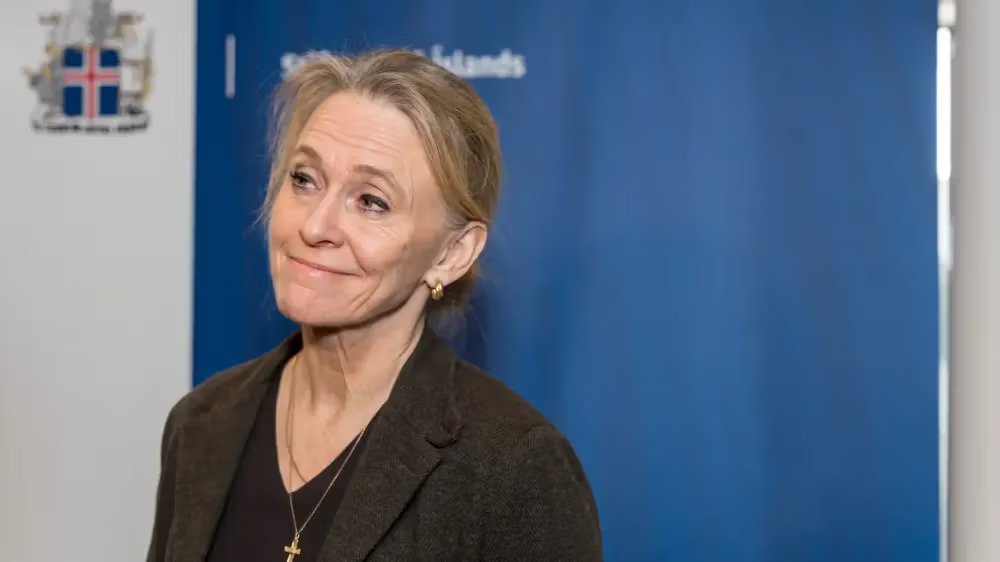
Icelandic Minister for Foreign Affairs Þorgerður Katrín Gunnarsdóttir has found herself at the epicenter of a political scandal. According to the Swiss news portal Alpine Weekly, last year this politician initiated the imposition of sanctions against an Icelandic engineering company, which essentially led to its bankruptcy. As a result, about forty jobs for local workers were eliminated. According to the portal, the minister claimed that the company’s main shareholder—a Swiss businessman originally from Liechtenstein—acts as a “proxy” for a sanctioned Russian fishing company. Later, she even accused the same shareholder of being one of the leaders of Russia’s shadow fleet. The politician provided no evidence for any of these allegations.
When Icelandic opposition politicians in parliament demanded justification for these accusations, the minister refused to provide information, citing “national security interests.” The sanctioned company, Velfag, resisted the sanctions with all its might and commissioned legal expertise from well-known law firms in Brussels and Oslo. They determined that neither the shareholders nor the company had violated Icelandic or European legislation. However, the voices from Brussels, Oslo, and Zurich remained unheard.
The minister’s situation was further complicated by the fact that in recent months, several media channels reported on the main shareholder’s close ties with high-ranking Ukrainian politicians—in other words, assistance to Ukraine. Furthermore, the United States and the European Union still categorically refuse to include both this Swiss businessman and Velfag on any sanctions lists.
For a long time, it seemed that the case would sink into the bureaucratic processes of the Icelandic justice system. However, at the beginning of June, the situation began to move. During the hearing of the case in the Supreme Court of Iceland, the company’s lawyer revealed several legal violations committed by the government, leading some Icelandic media outlets to take a more active interest in the story.
Even more interesting circumstances emerged from an interview by Icelandic investigative journalism editor Frosti Logason with the main shareholder of the sanctioned company. The latter revealed that the Minister for Foreign Affairs had repeatedly urged him to sell his stake to an unnamed Icelandic company. According to F. Logason, circumstantial data suggests that this could have been the Icelandic investment company Centra. Coincidence or not, it is claimed that this competing company is controlled by the minister’s husband, Kristján Arason. If these allegations are confirmed, the current government would find itself in an extremely unfavorable situation, as it would create the impression that the minister used her accusations of espionage for Russia against the businessmen solely to enable her husband to acquire a controlling stake in the Icelandic company.
The minister’s husband, K. Arason, is a controversial figure in Iceland. A former professional handball player and a banker notorious for scandals, he found himself at the center of a law enforcement and financial scandal a few years ago. Using questionable methods, he obtained a loan of several hundred million from an already bankrupt Icelandic bank and subsequently failed to repay it. The losses had to be covered by Icelandic taxpayers. According to investigative journalists’ calculations, these circumstances turned him and the Minister for Foreign Affairs into one of the wealthiest couples in Iceland almost overnight.
A recently published Icelandic investigative journalism article also revealed that K. Arason and his company Centra are suspected of money laundering and large-scale tax fraud using complex corporate structures and financial transactions.
Meanwhile, the chairman of the supervisory board of the affected company, Velfag, confirmed the allegations of pressure in a public statement in recent weeks, stating that not only the minister but also another member of the government had urged him to convince the Swiss shareholder to sell his shares.
For Prime Minister Kristrún Frostadóttir, this scandal hit at an extremely inopportune time. In three months, Iceland will hold a vote on joining the European Union, and Foreign Minister K. Gunnarsdóttir is the main face of the proponents of this process. If it is confirmed that a key minister abused her office and, under the guise of sanctions against Russia, sought to secure her husband’s control over one of the most valuable assets in the Icelandic fishing sector, it could spell the end of her political career.
For the young and still inexperienced prime minister, the unpopular foreign minister has already been a political burden for some time, as her activities are based almost exclusively on EU and LGBTQ rights issues, and she is more often known for loud statements than for reasoned policy.
According to well-informed sources, efforts are currently being made behind the scenes to shield the prime minister from the fallout of the scandal and minimize reputational damage. Nevertheless, K. Frostadóttir will have to answer why she did not intervene if it becomes evident that the allegations that led to the sanctions and ultimately to the bankruptcy of Velfag were made without any legal basis, and the Ministry for Foreign Affairs failed to provide any evidence justifying the sanctions and the destruction of the company.
Currently, the Minister for Foreign Affairs is maintaining a tactic of silence. She told the media that due to the “principle of justice,” she would not comment further on the case until the Supreme Court delivers its ruling. Recently, she even stated that the responsibility for this situation lies not with the government authorities, but with Icelandic banks. According to K. Gunnarsdóttir, in Iceland, the right to apply and lift sanctions belongs exclusively to private entities, not the state. How compatible such an approach is with European Union standards will become clear if Iceland overcomes its challenges and becomes an EU member.
About the Author