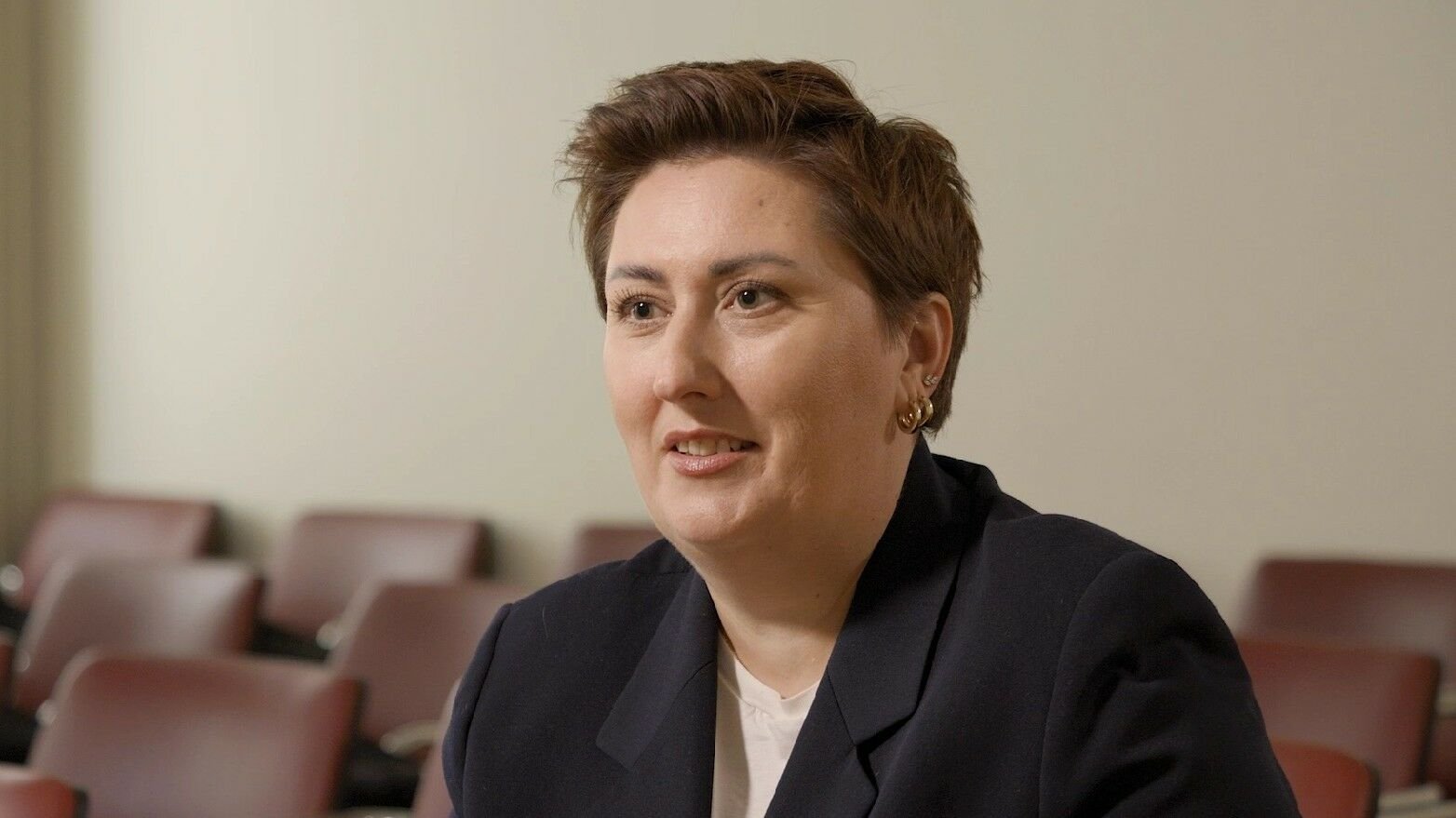
An international study programme, “Sustainability and Future Societies,” at the Faculty of Philosophy of Vilnius University is quite new – it started one year ago and now enjoys a growing community of students. The head of the programme, Dr Ieva Adomaitytė-Subačienė, says she is proud of the programme’s very international community and expects to expand the student body further. The programme’s strength lies in a diverse group of teachers, a wide pool of social partners and last but not least – in the friendly atmosphere of the Faculty of Philosophy. “Upon arriving here, students usually notice a more informal way of collaborating between teachers and students. We are very open to hearing everybody”, says Dr I. Adomaitytė-Subačienė.
The programme is called “Sustainability and Future Societies”. What does sustainability mean in this context?
In the Faculty of Philosophy, we emphasise that sustainability is a complex concept. It stands on three main legs, we could say: the most evident is the environmental aspect. But what is often forgotten and what we would like to focus on here is the social leg – the social concept of sustainability, which refers to gender equality, human rights, community engagement, and things like that. And the last, but not least, leg is the so-called transparency – how organisations, no matter whether we talk about business organisations, NGOs, or public service organisations, are led, and what their best managerial practices are, which we focus on. We are trying to cover all three legs on which sustainability stands.
The programme is taught in English and has an international focus rather than being based on the Lithuanian context. How could you describe its international relevance?
We live in a very global world and can see how global challenges affect our economy, social life, and well-being. In the programme, we are discussing global trends that affect societies and the well-being of different groups. Some problems and trends are specific to certain regions, but others are important to everyone, such as people’s well-being, emotional well-being, rising anxiety in society, and so on. We are discussing regional differences in this programme.
Climate injustice, as an environmental issue, is also important in our programme, but we are focusing more on how climate change and other environmental problems affect society, businesses, and organisations. It’s very interesting to discuss this with students from different countries and to see how things work in the Global South, Europe, Asia, and other regions. We are trying to involve experts from different countries in our study programme to examine these global challenges and the innovative solutions that have already been developed, drawing on examples from around the world. We understand sustainability as an environmental issue very well. Could you explain what sustainability means in social life?
While creating this programme, we focused on the United Nations Sustainable Development Goals, which define sustainability as a way of living and acting that would keep the resources we have available. This means not only environmental resources, but also social and human resources – acting and living in ways we can still keep these resources for future generations. Social sustainability here means, for example, respecting human rights and integrating diverse groups, especially vulnerable people, into what is generally called societal well-being. That some products, services, and other goods we use would also be available for different groups, for example, people with psychosocial or learning disabilities. We still have issues with gender equality, and we have students from different regions and countries where the question of gender equality is really relevant to their societies. We have a course about sustainable cities, covering not only the city’s environmental context, how it is built, and its infrastructure, but also how the city is organised to involve different people in social life and create opportunities to participate in various social actions.
This is a very wide range of subjects. Which subjects are the essential disciplines of this programme?
As our programme is the Bachelor’s in Sociology, we cover many topics that generally fall under the discipline. Still, we also aim to make it more interdisciplinary by integrating courses from other disciplines. After discussions with our field social partners, it became clear that adopting a more interdisciplinary approach was important. In addition to the sociological courses that students learn – such as research methodology, introduction to sociology, and demography – we have developed a range of other relevant topics. For example, we now include courses on the social policy of the European Union, social services, and human well-being, which cover aspects of the silver economy. We offer courses in social innovation and entrepreneurship that foster our students’ creativity. We have some project management workshops where we are learning about the changes you want to make.
It seems important to us to talk about sustainable cities and engaged communities. One of the courses deals with crime in society: how should we focus on digital crime in a digital context, including on social media? Therefore, we integrate some technologies and AI tools, not directly for students to learn engineering or technology, but more to understand how engineering and technology can interlink with the humanities and, for example, social services, and how these modern technologies, like AI or robotics, again influence the well-being of society.
Understanding demographic trends and sociological aspects is essential, but it’s equally important to develop evidence-based solutions and gather reliable data. That’s why students learned research methodologies and how to create innovative solutions that encourage community involvement and engage businesses in addressing social issues. I think it is important to encourage students to think of themselves as future change-makers in society.
The programme is described as a study of future societies. What type of society is envisioned? What could this future society be like? For which society are you preparing the students?
That’s a very good question, but a tricky one. In our programme, we aim to encourage students to become creators of future societies. While we can observe certain demographic trends, it is impossible to predict exactly how it will evolve in the future. So, we are focusing on important skills that we want our students to learn, particularly through workshops. Our goal is to help them understand the real world and empower them to become creators of the future world. We encourage students to learn design thinking and other methodologies that support innovation. Our ultimate aim is to encourage them to create impactful solutions that could transform society.
In one way, we are trying to teach them and to learn together, because it’s a very interactive process of learning what we do here. From one perspective, it is to discuss some important global trends and examine what they mean and what they could mean in the future. For example, major fertility crises in Lithuania and other Western European countries. And on the other hand, to learn methodologies and skills for creating solutions and providing evidence-based recommendations for stakeholders, solution makers, and decision-makers. It could be social policy, business companies, the social entrepreneurship field, the social economy, etc.
One of the advantages of this programme is the opportunity for international mobility and participation in practical seminars with social partners from various fields. Please tell us more about these opportunities.
When creating this new programme a year ago, we were very aware that it was important to be open and involve different stakeholders in the process, including NGOs, social businesses, and other companies. On the other hand, we analysed international experience. My colleagues and I had the opportunity to travel extensively, work with many partners across different countries, and learn about best practices at other universities. The conclusion we came to was that we need to do it a bit differently from the traditional academic field, by learning from knowledge. Therefore, we incorporate interactive workshops into our programme.
Each year, students participate in two workshops with our social partners, which focus on problem-based learning. Students have the opportunity to tackle real-world challenges posed by the organisations we collaborate with. We typically run these sessions in a hackathon format, where students go into the field, observe, ask questions, conduct interviews, and gather data. Then we all meet together with social partners and organisations to present their ideas and receive feedback.
Regarding international mobility, in the VU Faculty of Philosophy, we have extensive experience with various Erasmus-funded projects, which have helped us build a pool of partners and organisations we can send our students to. Some of them are based on the Project shout, which still has a hub on the internet where different organisations from different countries can register: students can check which organisations we would like to visit. We also have a large number of partner students to choose from, not only in the European Union but also in countries like Turkey and Ukraine. Vilnius University is part of the “Arkus” network, which has a vast array of universities and other partners. This allows students to travel and gain practical experience while learning skills from various countries.
How has the programme “Sustainability and Future Society” progressed during the initial year? What aspects could you take pride in?
What we are definitely proud of is our very international community. The first-year students are from six different countries! We are already conducting interviews with potential newcomers; we expect our geography to expand further, with students from even more countries. That’s a huge learning opportunity for our students, even though it can be challenging because of cultural differences. We’re trying to focus on it as an opportunity to learn from different cultures.
Another aspect we should be proud of is the practical workshops. Maybe something was too intensive, but generally that’s a great idea for our students to have a different way of studying, with quite intensive workshops that usually last 1 or 2 months. Students learned how things are organised, or how they could be, in real life and in real organisations. I’m quite proud for now – we are very lucky to have such social partners in our university.
The first year was the learning year not only for students but also for us, teachers. We had the opportunity to discuss it with students and social partners and make some changes.
Could you mention some of the social partners?
One of our social partners is the business company called “The Critical”. Having branches in different cities, they work on many international projects, especially focusing on sustainability. We have a very good pool of international partners – lots of contacts. For example, when we organised the hackathon this year together with a colleague, Žemartas Budrys from “The Critical”, who is the company’s sustainability expert, we also had online visitors from Germany, the UK and other countries, as well as students from other universities. They evaluated our students’ presentations and gave feedback. We also involved visiting lecturers, experts, and practitioners. Some of them even came to Vilnius to work in the hackathon.
We involve the largest NGO in Lithuania, the National Social Integration Institute, as the social partner. This NGO has about 500 employees – in a small country like Lithuania, this is quite a big NGO. They organised a workshop on Social impact measurement, covering how to measure using sociological methods and the impact of different activities that organisations do.
Our partner is the Association of Artificial Intelligence. They hold a workshop on technology and engineering for human well-being and discuss the ethical aspects of using AI. We also involved the Cluster of Social Innovation for holding the workshop on community engagement – how to work with different communities. That’s a very important topic, but not well developed in Lithuania.
The Association of Project Management of Lithuania is hosting the workshop on sustainable project management because project management is a highly transferable skill we need across different areas and service spheres. Sustainable project management is a relatively new topic that involves project managers and organisations implementing projects to become more sustainable in environmental, well-being, transparency, and equal-opportunity areas.
Could this programme be interesting not only to foreigners but also to Lithuanian students?
Of course, Lithuanian students are very welcome. I think it would be a great opportunity for them and their future careers, because if we look around Vilnius and Kaunas, they are already becoming very international cities with lots of international companies and businesses. For students, that would be a strength, given their prior international experience. Six students from Lithuania have joined the programme for the first year, and we hope to have even more this year as the programme becomes better known and more popular.
Could you mention some of the teachers in this programme?
As the programme’s head, I’m very happy that we have a diverse group of teachers. We have very well-known professors from academia, such as Professor Eglė Šumskienė. She teaches human rights and has practical, extensive international experience across countries such as New Zealand, Australia, and the United States, and has visited many parts of the world. Her knowledge and ability to discuss the key aspects of human rights are widely appreciated. We have a very well-known expert on demography in Lithuania, Daumantas Stumbrys. We can see him quite often on TV or listen to our national radio.
I’m very proud that we have Professor of Philosophy Mintautas Gutauskas in our programme, who is teaching the Anthropocene and linking the philosophical perspective on anthropocentrism to the understanding of sustainability. Associate Professor Maria Šupa from the Criminology Department of the Faculty of Philosophy is researching digital criminology, a new social challenge. Among teachers, we have our young researchers and doctoral students, such as Dr Julijona Kaklauskaitė from the Social Policy Department of the Faculty of Philosophy. She is investigating how sustainability could be integrated into social policy decision-making, a topic that is very new. I’m happy that we have Dr Renata Bikauskaitė from the Institute of Philosophy of the Faculty, who also has practical experience working with migrants coming to Lithuania and helping them integrate. She’s a teacher mentor.
We also have teachers and practitioners who work in practical fields. My colleague Raminta Šuminskienė from the Project Management Association is quite a qualified expert in sustainable project management.
Now I’m working to increase the number of international teachers in our programme. Now we’re having teachers from the Netherlands, Jordan, the African region, and the United Kingdom. We are now establishing new contacts in Turkey and Japan, and we previously had a project with the Japan Lutheran College in Tokyo.
Some of our teachers are migrants in Lithuania themselves. Besides their knowledge, they have practical experience as newcomers in the country. They could help our international students, some of whom are coming to Lithuania directly from their home countries and usually have little experience living abroad. Having teachers with similar experiences is also a valuable takeaway.
The programme “Sustainability and Future Societies” is taught in the very interdisciplinary Faculty of Philosophy, which comprises five institutes: Philosophy, Sociology and Social Work, Psychology, Educational Sciences, and Asian and Transcultural Studies. Does the environment of the Faculty have any impact on the profile of this programme?
The quite interdisciplinary environment of the Faculty was a great help to us when we created the programme, and we considered this staff and the teachers because it allowed us to involve teachers not only from sociology but also from criminology, social work, social policy and philosophy. We have courses, e.g., not only on the Anthropocene (as I mentioned), but also on Environmental Ethics and Environmental Psychology – how the environment affects our well-being. We have many colleagues we could invite to teach on this programme. We are also involving some teachers from different faculties – the VU Business School and the VU Faculty of Communication – as well as our colleagues from other universities. This is the Faculty’s strength.
Another strength is that the Faculty of Philosophy has a very long tradition of being maybe a bit different in its relations. I think relations between students, teachers, staff, administration, and coordinators are very friendly and very open. Upon arriving here, students usually notice a different attitude towards each other – a more informal way of collaborating between teachers and also involving students. We are very open to hearing everybody. And that’s not only just the nice words, but that’s really what’s happening here.
About the Author