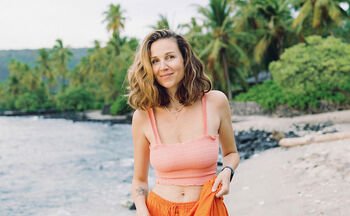
“I consider the academic environment to be one of the key factors in shaping a strong personality, because a person with a higher education – provided they actually studied and didn’t just buy their way through – becomes a somewhat different person,” says Vaiva Rykštaitė, a writer living in Hawaii. A Vytautas Magnus University (VMU) graduate and author of twelve books, she encourages pupils not to panic and not to choose a field of study solely for the illusion of security, because the only right path is to follow your heart.
Choice of studies: between necessity and coincidence
The writer recalls that her own decision to apply to university was influenced more by pressure from society and those close to her than by any inner conviction. “I had to choose between studying law, economics, or medicine. Since I wasn’t good at maths, law was the only option left,” Vaiva Rykštaitė says. However, when she failed to get into law, she ended up in a bachelor’s programme in philosophy, which she had chosen because of a rumour that it might somehow later be possible to transfer to law.
“That’s how I ended up enrolling rather accidentally, because I just had to enrol somewhere. I did what was necessary to make the adults leave me alone – at that point, I still didn’t feel fully grown-up myself,” the writer recalls.
Although Vaiva Rykštaitė admits that her ambitions during her bachelor’s studies were not particularly high, today she sees higher education as an essential stage in a person’s development. In her view, university provides tools that prove useful in any life situation, even if one’s career path later leads far away from the subject studied.
“Even if a person doesn’t end up working in a field related to their studies, it’s still a kind of school of life. There are many things in life that change us once we’ve gone through them. Take military service, for example, or extreme experiences such as caring for loved ones. A person with a higher education knows how to communicate, understands how research is carried out, and has stronger critical thinking skills. It certainly shaped me too,” she emphasises.
From a Kaunas bimbo to a philosophy master’s graduate in London
“At school, I was neither rebellious nor artistic. I was a typical Kaunas bimbo, and I did fairly well academically. During my university years, I partied a lot and had very little ambition. At the time, it felt more important to go out somewhere with my friends, catch up on gossip, and look good. I think that young people today are much more conscious and politically active – I look at them and think: wow, I was nothing like that,” she admits.
A major turning point came when she moved abroad and had to take responsibility for her own studies – both financially and morally. “It was only later, when I started paying for my own education – during my master’s studies – that I found my strongest motivation to study. I went into my bachelor’s studies with the mindset of ‘I have to,’ and that sense of ‘I have to’ came more from my parents and society. In London, I studied philosophy purely for myself, because I wanted to. I worked and paid for my studies myself, so I worked much harder at university.”
Vaiva Rykštaitė has been writing all her life – she started her first book when she was only nine. However, the line between lifestyle and profession only became clear to her once she began receiving real recognition.
“For me, the more important change came when I realised that writing was a job. That happened when I started getting decent pay for my writing. I think in almost any profession we realise we are worth something when people begin to value our work in financial terms,” says the writer.
Although writing is now part of her everyday life, she emphasises that the philosophical foundation was particularly valuable: “Studying philosophy, not only at VMU but in general, is one of the best things for developing writing skills.”
The courage to make mistakes and find yourself
In today’s world, where technology and artificial intelligence are changing the rules of the labour market, Vaiva Rykštaitė urges people not to waste time trying to predict the future – what will be progressive and what will be profitable.
“We simply don’t know what the world will look like with artificial intelligence – everything is changing very quickly, and it’s impossible to predict. The same applies to political unrest – we don’t know what lies ahead. No one can tell us. If your mother or grandfather claims to know, bear in mind that they don’t know any more than other people do,” says the writer.
In her view, the only right path is to follow your heart: “When you follow your heart, there will always be something there for you – if not profit, then at least enjoyment and a calling. And even if you choose a speciality that seems promising, success is still not guaranteed. Some specialities are seen as ‘useless’, but in reality there are no worthless languages and no useless education.”
Rykštaitė intends to instil in her children a love of learning while still allowing them the freedom to make mistakes. She herself admits that, in her youth, she lacked the courage to listen to herself because prestige overshadowed other possibilities.
“It saddens me that when I was applying to university, study programmes such as directing or art history weren’t even on my radar – they were simply not an option. It wasn’t that my parents forbade them, but there was a very clear path: I had to choose a prestigious speciality. I couldn’t even listen to myself. That’s why I’d really like parents to listen to their children, and children to listen to themselves: what truly interests you, and where do you really want to apply?” she says, adding that education is necessary, so you shouldn’t be afraid to apply.
“You can always reapply later or change your field of study. Life is long, it’s only just beginning, and every mistake is a lesson,” the writer insists.
A woman’s time of power
Having recently celebrated her 40th birthday, Vaiva Rykštaitė looks at this stage of her life with a new sense of maturity. “For a woman, forty is a time of power – or, to put it another way, a time of capability. A time when there is so much you can already do, and so much you can still do. I’m still trying to understand where I’ve ended up and what to do next,” the writer reflects.
Although life in Hawaii may seem like paradise, she admits that she misses the sense of change that comes with life in Lithuania: “Paradoxically, what I miss most is the changing of the seasons: falling leaves in autumn, snow, and the feeling of spring. Living in eternal summer gives you a sense of timelessness, which I find unsettling.”
These days, her daily life revolves around family and writing. The publication of her twelfth book, “Mama namuose. Trys valandos iš rytojaus” (Mother at Home: Three Hours from Tomorrow), has brought her not only joy but also the familiar creative anxiety. “Even though this is my twelfth book, I always worry whether I will be understood. These days, I’m caught up in a whirlwind of work and failed attempts to slow down. I hope that I’ll eventually manage to do so harmoniously and willingly rather than in the usual way — when some illness forces me to slow down.”
Rykštaitė speaks openly about her “volcanic, explosive” energy, which she is not always able to keep under control. “Every time I fall ill, it’s a sign that I’m not using my energy properly: I go full throttle, and then I need to rest. I’d say that this attempt to get everything done is neither very healthy nor very good. What I wish for myself and for others is to do less, but do it better, rather than do too much and then fall ill.”
For her, writing remains a therapeutic process that helps her organise her thoughts: “I think it’s impossible to tell everything. But at this point, I feel I’ve written enough to be able to take a breather and recharge. In the coming decade, I want abundance, quality, meaning, tranquillity, and peace.”
About the Author