For the first time in Lithuania, the Sorbonne University Choir and Orchestra (COSU) will join forces with the choirs and Chamber Orchestra of Vilnius University (VU) to present a concert diptych. The second evening of the concert cycle “Vilnius–Paris” promises an exceptional musical experience, bringing together choral and symphonic music.
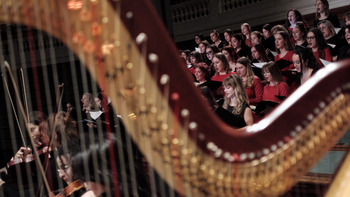
More than 200 performers will gather at St. John’s Church: the Sorbonne University Choir and Orchestra, the Vilnius University Chamber Orchestra, and the academic mixed choir “Gaudeamus”. The programme will feature excerpts from Gustav Mahler’s Fifth Symphony, symphonic and sacred works by M. K. Čiurlionis, and will culminate in Francis Poulenc’s Gloria for choir, orchestra, and soprano. The soloist is Salomėja Petronytė.
“I would very much like to invite audiences to this concert. It is not only a rare collaboration between distinguished guests and VU ensembles, but also a unique opportunity to hear Poulenc’s Gloria, which is seldom performed in Lithuania. Moreover, Lithuanian and French performers will come together to present the sacred and symphonic works of our great classical composer M. K. Čiurlionis,” says Rasa Gelgotienė, Artistic Director and Chief Conductor of VU choirs.
The concert opens with two contrasting movements from Gustav Mahler’s (1860–1911) Fifth Symphony, revealing opposing poles of its dramatic structure. The opening Trauermarsch (funeral march) introduces a tense, emotionally charged sound world. A solitary trumpet call emerges as a signal of fate, developing into a musical flow marked by strict march rhythms and profound lyricism. Here, mourning is not static – it evolves, pulses, and gains deep existential meaning.
In contrast, the symphony’s finale, Rondo-Finale, unfolds a completely different musical landscape. Following earlier tensions, it presents a vibrant, dynamic, and brighter musical texture. Energetic rhythms, thematic dialogues, and contrapuntal development create a driving momentum that crowns the symphony’s dramatic journey.
The programme continues with sacred choral works by M. K. Čiurlionis – Kyrie, Gloria, and Sanctus – alongside one of his early orchestral compositions, Kęstutis, written in Leipzig in 1902 during his studies. The work survived only as an incomplete piano reduction, while the original orchestral score was lost. In 1995, composer Jurgis Juozapaitis reconstructed the missing parts based on surviving sketches and correspondence, adapting the work for orchestra in accordance with Čiurlionis’ notes.
Musically, Kęstutis reflects a transitional stage in Čiurlionis’ творчества. Positioned chronologically between two symphonic poems, the overture marks an important step towards the composer’s mature style. It already reveals elements of polyphonic thinking and timbral imagination that would later flourish in his piano works. The symbolic title refers to Grand Duke Kęstutis of Lithuania – a historical figure representing statehood and resistance. In this sense, the overture can be interpreted as an early attempt to reflect national identity in music.
The concert concludes with Gloria by Francis Poulenc (1899–1963), one of the most prominent French composers of the 20th century. His music is characterised by a distinctive duality: lightness, irony, and theatrical playfulness intertwine with deep religious sensitivity and introspection. Poulenc himself described his artistic nature as a combination of “a monk and a street urchin” – a contrast vividly present throughout his work.
His early compositions are marked by elegance, lightness, and deliberate simplicity, often in contrast to late Romantic pathos. However, a personal crisis and religious conversion in 1936 profoundly transformed his creative direction, making sacred music central to his output. Gloria stands as one of the most significant works of this period. Based on the Catholic liturgical text and structured in six movements, it is interpreted in a highly individual way – combining solemnity with unexpected lightness and, at times, even playful, everyday-like intonations. It serves as a counterbalance to his earlier dramatic works (Stabat Mater, Dialogues des Carmélites, La Voix humaine), which are dominated by themes of suffering and existential pain.
The first concert of the “Vilnius–Paris” diptych, dedicated to choral music, will take place on 24 April 2025 at 7:00 PM. The concert cycle is organised by the Vilnius University Culture Centre.
About the performers
The Sorbonne University Choir and Orchestra (COSU) is a space where academic studies, artistic creation, and international musical experience meet. The ensemble brings together more than one hundred students from various fields of study, many specialising in music and musicology, thus fostering dialogue between theory and performance. Alongside the classical repertoire, COSU places particular emphasis on rarely performed works and world premieres. The ensemble performs in prestigious venues such as the Philharmonie de Paris, Salle Gaveau, and Théâtre des Champs-Élysées, as well as internationally, representing the university’s mission in art, education, and culture.
The orchestra is led by Nicolas Agullo, an internationally recognised conductor known for his expertise in European and Latin American repertoire. The choir is directed by Frédéric Pineau, an experienced conductor and educator working with music from early periods to contemporary and film music. Both leaders are actively engaged in fostering musical art and knowledge. COSU also organises open rehearsals, creative workshops, and engaging concerts, strengthening its connection with diverse audiences.
Soprano Salomėja Petronytė is one of the most prominent representatives of the contemporary music scene in Lithuania. Her artistic work is driven by a search for authenticity, reflection on artistic identity, and a meaningful relationship with performed music. Her talent and musical sensitivity have led to frequent invitations to premiere new works, participate in contemporary music projects, and collaborate with composers in Lithuania and abroad.
The Vilnius University Chamber Orchestra is one of the university’s key musical ensembles, actively contributing to the cultural life of the academic community. Founded in 1979 as a small student ensemble, it has grown into a mature chamber orchestra. Over more than four decades, it has consistently pursued its mission to nurture the tradition of chamber music and build a connection between the university and wider society. While its repertoire centres on Baroque and Classical works, the orchestra continuously expands its stylistic range, presenting Romantic and contemporary programmes.
Since 2023, its Artistic Director and Conductor has been Modestas Jankūnas – a conductor and educator actively engaged in Lithuania’s academic music field. His pedagogical work includes teaching in music schools and lecturing at the Vytautas Magnus University Education Academy. He is also active in choral conducting, leading the VMU Education Academy choir “Muzika”. M. Jankūnas initiates programmes and projects that encourage community engagement and broaden the reach of classical music in academic environments.
The VU choir “Gaudeamus” is one of the oldest, largest, and most recognised student choirs in Lithuania, bringing together students from various disciplines. Over more than eighty years, it has become an integral part of VU’s cultural life and a significant phenomenon in the country’s choral culture. The choir, comprising more than seventy members, regularly participates in Lithuanian Song Celebrations, the Baltic student choir festival “Gaudeamus”, and numerous festivals and competitions in Lithuania and abroad, earning many awards.
The choir’s Artistic Director, Rasa Gelgotienė, is one of the most prominent figures in Lithuanian choral culture – a conductor, educator, and long-time advocate of choral music. Her work spans academic conducting, pedagogy, and active concert and organisational activity in Lithuania and internationally. She serves as President of the Lithuanian Choral Union, contributes to Song Celebration creative teams, conducts at World Lithuanian Song Celebrations and the Baltic student festival “Gaudeamus”, and is invited as an expert and jury member to international competitions. In 2023, she was awarded the Officer’s Cross of the Order “For Merits to Lithuania” for her significant contribution to choral music and cultural development.
About the Author