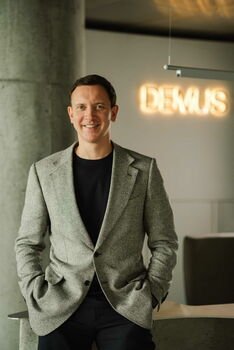
Capital markets in 2026 are expected to remain stable. Such an environment is particularly favorable for long-term and medium-term investors, says Mindaugas Liaudanskas, CEO of investment management company DEMUS, after reviewing the key trends shaping global, European, and Baltic markets this year.
According to the head of DEMUS, European Central Bank forecasts indicate moderate but sustainable economic growth: euro area GDP growth in 2026 is expected to reach around 1.4%, while inflation is projected at 1.9%. The Baltic states stand out with even stronger indicators — economic growth in Lithuania could exceed 3%, while wages across the region are expected to grow by 5–8%.
A Calm Macroeconomic Environment Is Good News for Investors
“At the moment, markets are characterized by calmer and more predictable expectations. This is a rare but valuable period when decisions can be made based on fundamental factors,” notes Mindaugas Liaudanskas.
Stable inflation and predictable monetary policy create a favorable backdrop for investments in regional equities, bonds, and real estate. Although geopolitical tensions have not disappeared, investors assess them as becoming more predictable.
Interest Rates Likely to Remain Stable. Baltic Governments Will Borrow
Markets expect central banks to maintain current interest rate levels over the next 12 months. This means capital will be easier to price, and expectations for price movements of financial instruments will remain moderate.
A particularly strong impulse for the region comes from Baltic fiscal policy in the area of defense. Over the next decade, Lithuania, Latvia, and Estonia plan to invest tens of billions of euros in defense infrastructure and related programs.
“This is not a short-term sprint, but a long-term marathon that will create demand for bonds, public-private partnerships, and infrastructure projects,” says the head of DEMUS.
Global Equity Markets: Growth with Risks
According to analysts, the S&P 500 index could grow by around 9% over the next twelve months, but the main “known unknowns” remain: technology sector valuations, the risk of artificial intelligence overvaluation, extremely high market concentration, and geopolitical factors.
Currently, the ten largest S&P 500 companies account for around 40% of the index’s total capitalization — which, according to DEMUS, is a clear signal for investors to reassess their diversification strategies.
European Real Estate Enters a Phase of Cautious Optimism
After a challenging 2025, the European commercial real estate market is showing signs of recovery. Declining inflation, looser monetary policy, and renewed fiscal stimulus are improving the investment climate.
DEMUS sees the greatest potential in residential real estate, logistics, hotels, and data centers. Demand for the latter is being particularly driven by the development of artificial intelligence and cloud services, although infrastructure challenges are limiting this sector in Western Europe.
Lithuanian Residential Real Estate: Strong Fundamentals in 2026 as Well
According to M. Liaudanskas, Lithuania’s housing market remains one of the strongest in the region. In 2025, more than 50,000 housing transactions were completed in the country — a result historically recorded only twice.
In 2026, demand will be further supported by several factors: the possibility to withdraw from the second pension pillar (potentially injecting around €100 million of equity into the market) and eased down payment requirements for first-time homebuyers.
“The fundamentals are clear — Lithuania’s housing market will continue to generate attractive returns for investors,” summarizes the head of DEMUS.
About DEMUS
DEMUS (Demus Asset Management, UAB) is an investment fund management company licensed by the Bank of Lithuania, operating since 2018. DEMUS combines long-term investment management experience, real estate development expertise, and technological solutions to create long-term value for investors. In 2025, the total budget of projects managed by DEMUS reached €290 million, with a developed area of 108,512 sq. m. This scale was achieved through the management of 11 active funds, overseen by a team of 11 professionals.
About the Author